

The course Curriculum Setup Register at AI Horizons ↗

Thu 29 & Fri 30 October 10:30 to 3:00 New York time

AI Tools for Data Analysis from chatbot to coworker

AI can now do nearly all the technical work in an analysis, and most of us are only scratching the surface. In two live days we learn to hand it a task, a project, then a whole process. No code.

Live on Zoom with Boris Nikolaev Thu 29 & Fri 30 October

Register ↗

Two days, in under a minute.

Everything in it was made with the tools we use in class.

Every July, the best coders in the world meet in Tokyo.

They compete in the AtCoder World Tour Finals. In July 2025, an AI joined them.

Jul 2025
    Today

      The whole story, in writing

      July 2025

      Humanity prevails (for now)

      Przemysław Dębiak (“Psyho”) against an OpenAI reasoning model. The model led for most of the ten-hour heuristic final; Psyho caught it at the very end, on three days of almost no sleep. The models weren't good enough for the algorithmic division at all that year.

      1Psyho human0
      2OpenAIAHC model0
      3terry_u16 human0
      The heuristic final, top three.

      July 2026

      Humanity surrenders

      The organizers reportedly picked a heuristic problem designed to favor humans. It didn't matter: Psyho reckoned the human field would have needed several more days to match the model. The next day it solved all five algorithmic problems, two that no human in the room cracked. Two “humanity surrenders” awards, one per division.

      HeuristicHumanity surrenders
      AlgorithmicHumanity surrenders
      The ¥600,000 “Humanity Prevails” award went unclaimed in both divisions.

      July 2026

      And then, new science

      Mathematician Levent Alpöge announced that Claude Fable 5 found a counterexample to the Jacobian conjecture, open for 87 years and independently verified within days. Timothy Gowers called it the first example he knew of an LLM solving a famous problem outside his own area.

      19392026
      Open for 87 years. The thread on X ↗

      September 2026

      A Millennium Prize problem

      Then OpenAI announced that about 10,000 of its agents, working for 88 hours, had proved that the Navier–Stokes equations (the equations of how fluids move) can blow up in finite time when pushed by a smooth force. It is one of the seven Millennium Prize problems, each worth a million dollars. The proof was checked by computer, and the Clay Mathematics Institute said the problem had “apparently been settled.” The unforced version is still open.

      • P vs NP
      • Riemann hypothesis
      • Hodge conjecture
      • Yang–Mills mass gap
      • Birch & Swinnerton-Dyer
      • PoincaréPerelman, 2003
      • Navier–StokesAI agents, 2026

      The seven problems, set in 2000. Two now settled. The Clay statement ↗

      Psyho spent twenty years becoming the best coder alive.

      The machine passed him in .

      twenty years
      twelve months

      Where will we be five years from now?

      • What will our jobs look like?
      • What is left for us to do?
      • And what should never be handed over?

      The truth is, nobody knows.

      But the nature of our jobs will radically change, and the responsibility will shift.

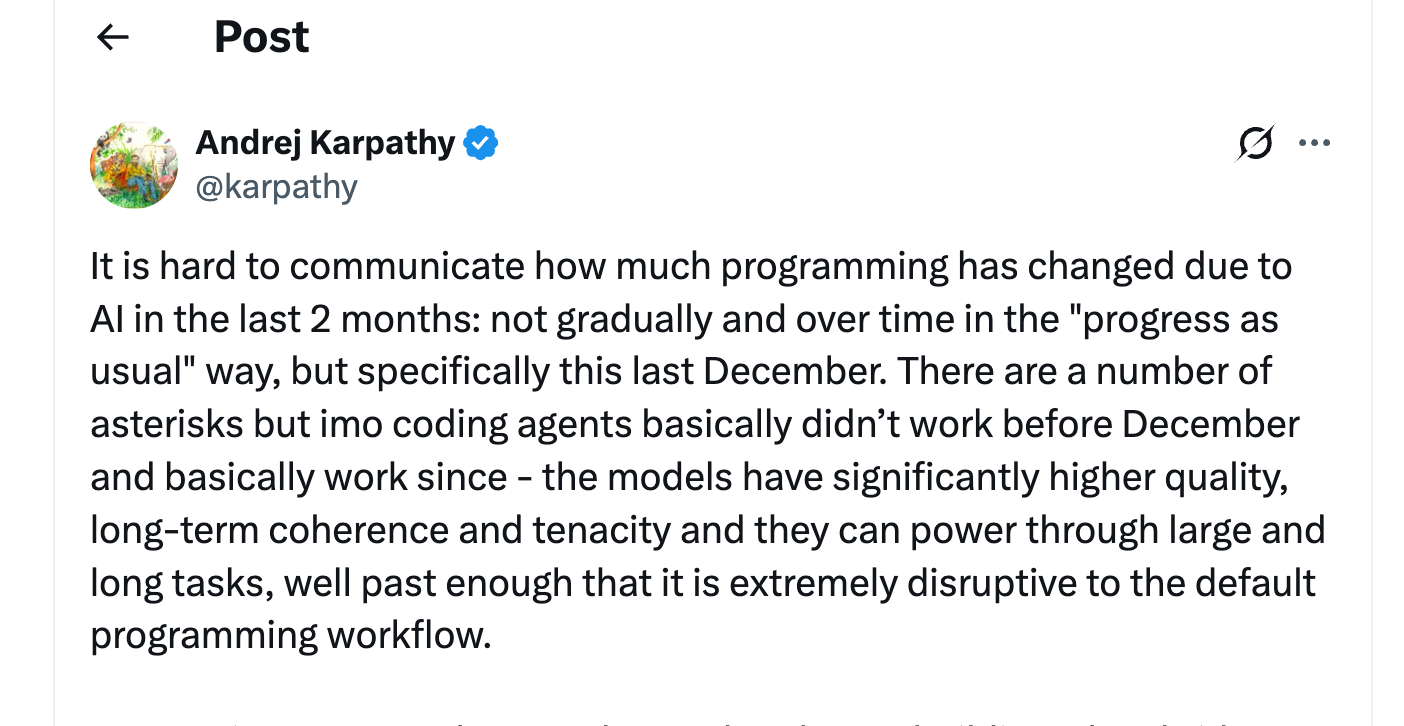
      For programmers, it already has. In February, Andrej Karpathy, one of the founders of OpenAI, wrote:

      Andrej Karpathy on X: it is hard to communicate how much programming has changed due to AI in the last 2 months; coding agents basically didn't work before December and basically work since.
      “It is hard to communicate how much programming has changed due to AI in the last 2 months.” Now with one word changed: programming, crossed out, becomes data analysis.

      Data analysis has already changed too.

      And it is only speeding up.

      From chatbot to coworker in less than four years. A short history.

      scroll to climb ↓

      Milestones are spaced evenly; the bands show the years.

      Most of us use this much. This is what’s underneath.

      Three levels of letting go.

      Each level hands the machine a bigger piece of the work and changes where we stand.

      Delegate a task.

      It writes the code, runs it, and hands back the receipts.

      Now cooking OLS + confidence bands

      Every number below is real. Pick another dish

      you▤ happiness_2023.csv · 2,363 rows

      claude 0.0s

      Day one, à la carte

      Prompting, the lean way

      Information, not incantations. “You are an expert data scientist…” Start plain, look at what comes back, add what was missing: context, goal, output, done. Once you know what you like, write it down as a skill, then one line is enough.

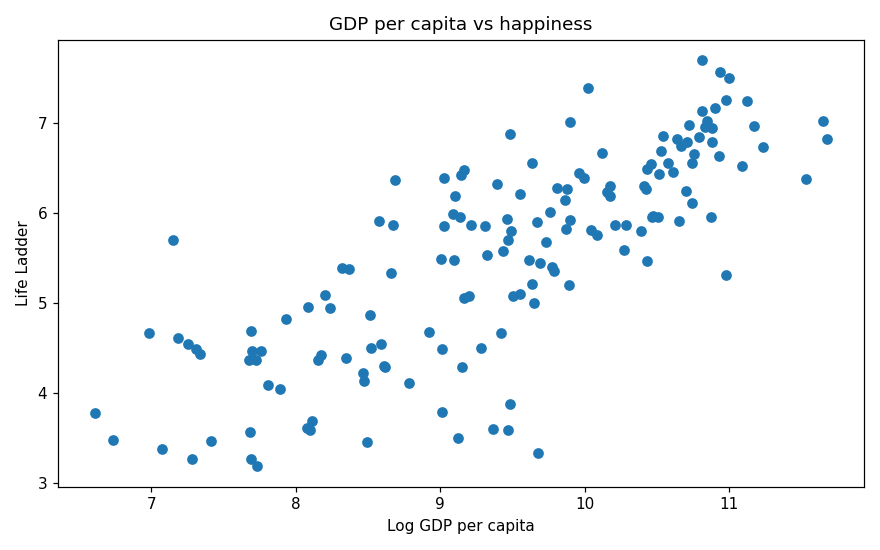
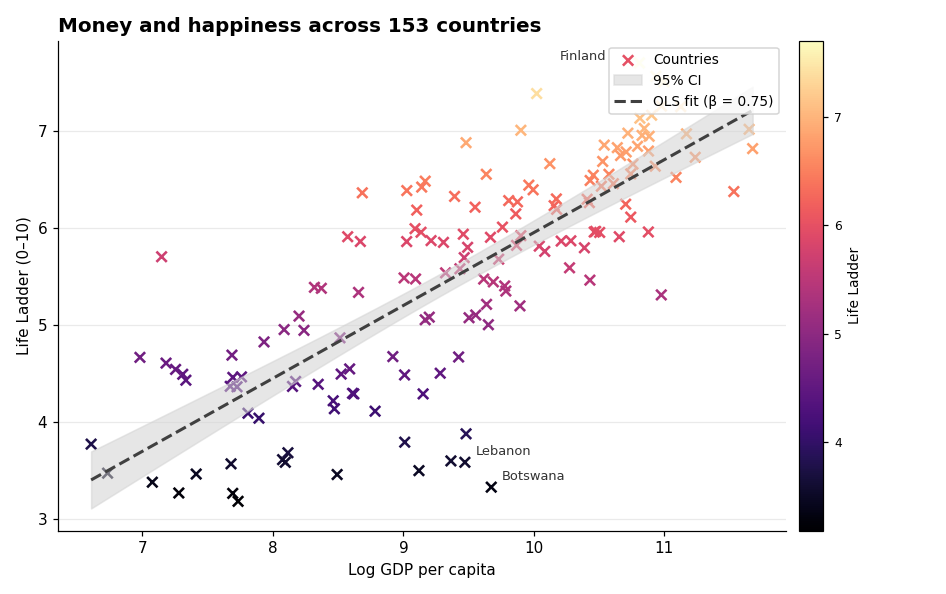
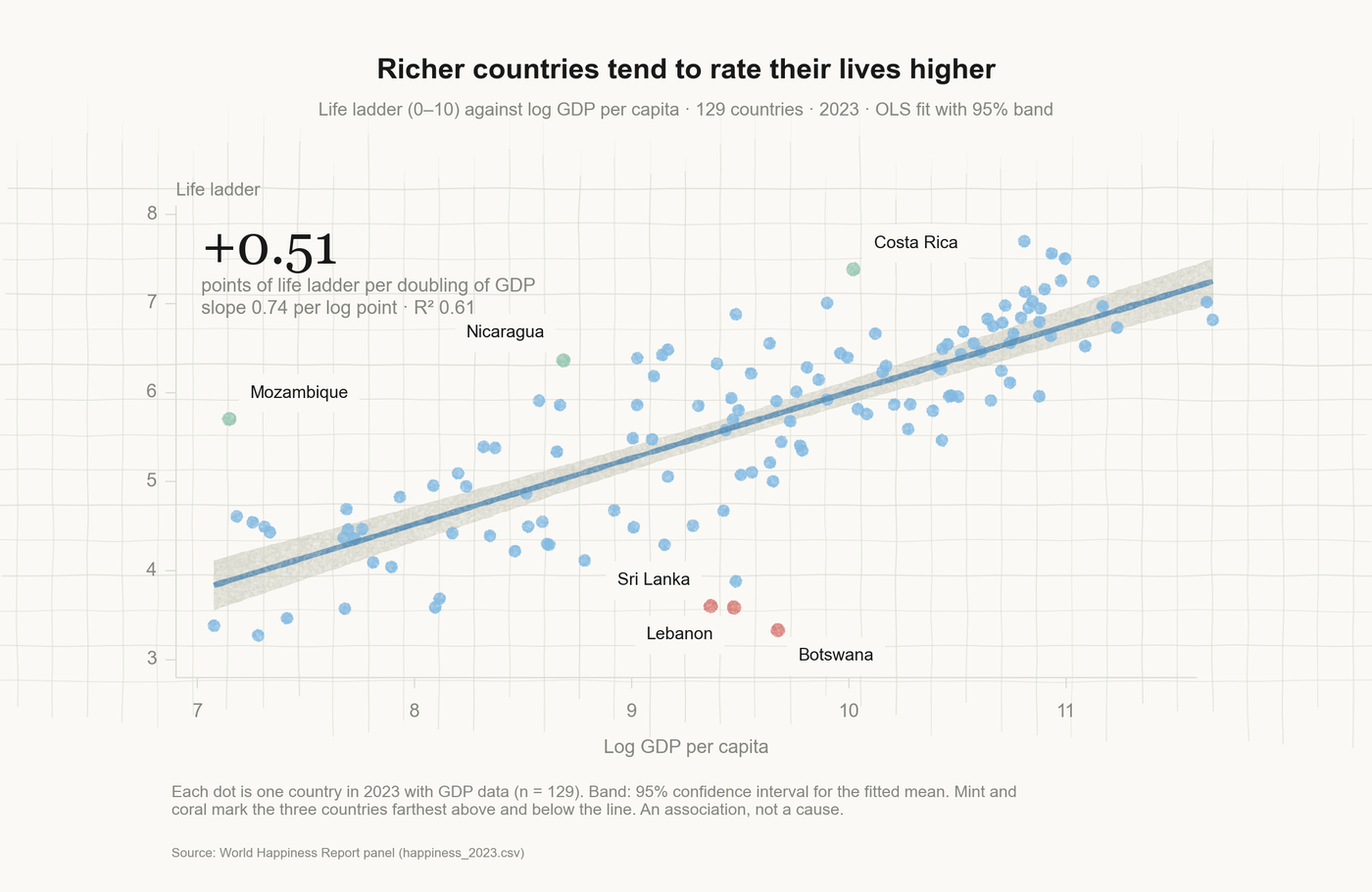
      The cold start: a default matplotlib scatter of GDP per capita against happiness. After two rounds: a magma-colored scatter across 153 countries with a dashed OLS line, a gray 95% band and named outliers. With the watercolor-graphs skill: the same question as a watercolor chart: 129 countries in 2023, a painted fit line with a 95% band, plus 0.51 points per doubling of GDP, and the three countries farthest above and below the line named.

      The same data, as a world you can paint.

      Move the brush across the map: each country floods with how its people rate their lives, and plays its note.Swipe to paint. Tap a country for its numbers.

      How happy is the world?

      Sound is on.

      less happyhappier· life satisfaction, 0–10, 2021–23

      0 of 165 countries painted

      Delegate a project.

      A folder, a goal, permission. Then we go to lunch.

      the-project/ · goal: “a full report on what moves happiness”idle
      • the-project/
      • data/happiness_2023.csv
      • papers/

      The house rules. Read first, every session.

      Noon. We press Run and go to lunch.

      Delegate a process.

      We write the check and the stop rule. The manager does the rest.

      The managergoal: “a full report on what moves happiness” agents 0loops 0checks 0/0
      stop when:

      One manager. It decides how many agents the job needs.

        “A loop is an agent repeating cycles of work until a stop condition is met.”

        Stop when the check passes, not when an answer merely exists.

        The worst errors are silent.

        The code runs, the chart looks fine, and the answer is still wrong. That is how OpenAI came to withdraw three of its 722 AI-written math papers a day after posting them.

        “The world has got sadder: average life satisfaction fell 0.83 points since 2005.”

          The author robot, proud of its chart

          or open the files yourself:

          Both means are right. The comparison isn't: about two-thirds of the “decline” is the survey growing.

          Four checks a machine can run. The fifth is ours.

          Beautiful is the default. Judgment isn't.

          The machine drew this chart. Which headline would you sign?

          Pick a headline to sign

          Four headlines, one chart, the same dots.

          What people took away.

          …interactive dashboards … were invaluable.
          Christine Davis, The National Center for Construction Education and Research
          read it all

          “The diversity in applications for using ChatGPT for data analysis, especially the creation of interactive dashboards and HTML to host on a website, were invaluable.”

          …I learned so much new information about what AI can do…
          Jane C. Daquin, Sam Houston State University
          read it all

          “I have been using ChatGPT every day since 2023 for research, teaching, and even creative writing, though primarily to code advanced statistical models. Despite this experience, I learned so much new information about what AI can do and its potential.”

          …explained all the topics very well… really interactive.
          Laura Fabregat, Universitat Rovira i Virgili
          read it all

          “I think Boris explained all the topics very well. He knows a lot and was really interactive. Data analysis and AI are very, very important topics that really help our academic career.”

          …very relevant and very cutting edge.
          Navendu Shekhar, American Association of Retired Persons
          read it all

          “This course was very relevant and very cutting edge. We learned about developments that happened in the last 3 weeks.”

          Questions worth asking.

          Three questions for the last hour. Take a side.

          Is AI making us stupid?

          sharperduller

          Which skills do you want to keep by hand, and why those?

          Are we going to lose our jobs?

          they changethey go

          Which of your tasks quietly became more valuable this year?

          What’s left for experts?

          lessmore

          What would you refuse to delegate, even when it’s cheap?

          The machines won the contest. The questions are still ours.

          Today

          Day one

          Thursday 29 October

          Register at AI Horizons ↗
          Register at AI Horizons ↗

          Live on Zoom, two four-hour days. Recordings for four weeks, captions on everything, every dataset and prompt provided.

          10:30 AM to 3:00 PM New York time Add to calendar

          Taught live by Boris Nikolaev, an economist who studies happiness, which is why every demo here runs on the World Happiness Report.